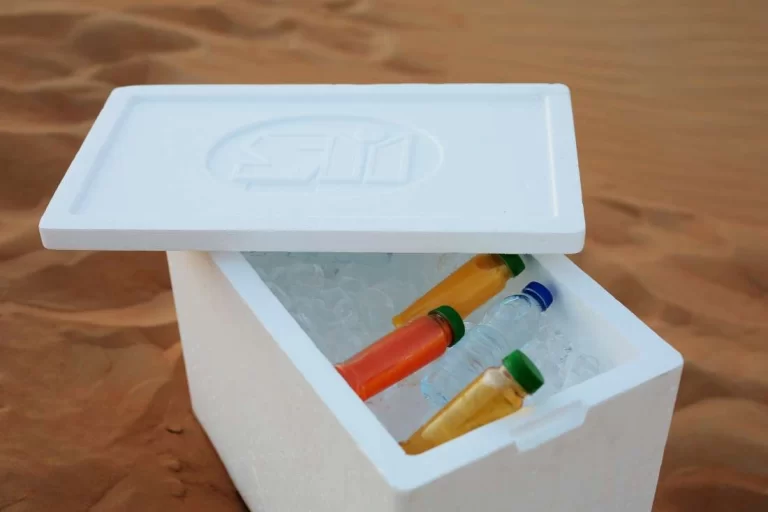
Cold-chain transport in the UAE is rarely a simple cold-room-to-cold-room movement. Product leaves controlled storage, passes through dispatch, enters a vehicle, changes hands, reaches a loading bay and is finally transferred into another controlled environment. In a market where summer outdoor temperatures can exceed 45°C, the packaging around the load has a real job to do during those intervals.
That is where Polystyrene Ice Boxes are particularly effective. Expanded polystyrene, or EPS, is a lightweight cellular material in which trapped air provides the thermal resistance. The useful point is not simply that the box is insulated. It is that a relatively substantial insulating wall can be achieved without making the package unnecessarily heavy.
For chilled seafood going from a processing facility to a hotel kitchen, a laboratory consignment moving between emirates, or food products travelling through last-mile distribution, that balance of insulation, protection and low handling weight is exactly what cold-chain packaging needs.
Cold-Chain Protection Has to Travel With the Product
Refrigerated warehouses and chilled vehicles provide the main controlled environment, but the product does not remain permanently inside either. Loading, unloading, cross-docking, order separation and final handover create short periods when the package itself becomes the immediate thermal barrier.
A properly packed EPS box gives each consignment its own insulated micro-environment. The benefit is operational as much as technical. The protection stays with the product from the packing bench to the receiving point rather than depending entirely on the temperature of the surrounding space at every stage.
Polystyrene Ice Boxes suit this role well because the insulation surrounds the load continuously while leaving enough usable capacity for the product and its refrigerant. Ice, gel packs or phase-change materials can be arranged close to the contents instead of cooling a much larger volume unnecessarily.
That is particularly useful on multi-stop UAE routes. A vehicle may be carrying several deliveries, with doors opening at different locations through the day. Each packed order retains its own insulated enclosure. For distributors handling hotels, restaurants, supermarkets, laboratories or clinics, that gives a practical additional layer of temperature control.
It also gives the receiving customer something straightforward: a consignment that remains protected during the final movement from vehicle to receiving bay and into storage.
EPS Is Well Matched to UAE Operating Conditions
The UAE climate rewards insulation that performs without adding avoidable mass. EPS fits that requirement neatly. Its cellular structure gives low thermal conductivity, while the moulded body provides rigidity, cushioning and useful resistance to the moisture encountered through condensation, chilled goods and ice-based packing.
The details matter. Box density, wall thickness, lid fit, internal dimensions and the ratio between product and coolant all influence the thermal behaviour of the finished pack. A well-made EPS box is not merely a foam container. It is a defined thermal enclosure.
Local sourcing strengthens the case. Working with established Polystyrene Manufacturers and Suppliers allows UAE businesses to select sizes and configurations that reflect actual route lengths, carton counts and product formats. Styrene Insulation Industry manufactures EPS products in Abu Dhabi and includes insulated ice boxes within its product range.
That local manufacturing presence is useful for repeat procurement as well. When a distributor needs the same outer dimensions, lid fit and internal capacity across regular shipments, consistency has genuine operational value.
The ability to select packaging around the actual product is preferable to forcing every shipment into a standard oversized container. Seafood trays need one arrangement. Small chilled food packs may need another. Laboratory packs can have completely different dimensional requirements.
Low Weight Improves the Entire Handling Cycle
The usual discussion around lightweight packaging concentrates on freight. In practice, a considerable advantage appears during handling.
A cold-chain box may be lifted from a packing table, stacked on a trolley, moved into a van, transferred at a receiving dock and carried again into chilled storage. A light container leaves more of the manageable load for the goods and refrigerant. Handling remains straightforward even when several boxes are moving through dispatch together.
EPS also brings cushioning into the same package. Glass containers, diagnostic materials, seafood trays, delicate produce, confectionery and prepared foods gain physical protection from the resilient moulded walls. Temperature-sensitive goods usually need to arrive in sound physical condition as well as at the correct temperature. Combining those functions in the container makes sense.
Polystyrene Ice Boxes can also be manufactured in predictable external dimensions, which helps with van loading, pallet planning and cold-room staging. Empty units are easy to position, while filled units remain comparatively manageable.
The wider family of Polystyrene products uses the same material advantages in different ways. Expanded Polystyrene Sheets, for instance, apply EPS insulation to building and industrial applications; the moulded ice box takes the same thermal principle and turns it into a portable enclosed package suitable for distribution.
That combination of thermal efficiency, cushioning and low weight is difficult to overlook when a business is moving chilled consignments every day rather than occasionally.
The Same Insulation Principle Serves Several Cold-Chain Sectors
Seafood is perhaps the most familiar application. Fresh fish, shellfish and other chilled marine products benefit from an insulated box that can hold product and coolant in close proximity while providing cushioning during transport.
Food distribution goes much wider than seafood. Meat, dairy products, desserts, bakery fillings, specialty ingredients, meal kits, fresh produce and selected beverages can all be handled in insulated EPS packaging where the route requires a portable thermal barrier. Catering suppliers also gain a tidy way to separate individual customer orders inside a larger refrigerated delivery operation.
Healthcare logistics uses the same physics with more tightly controlled procedures. Certain medicines, diagnostic specimens, laboratory reagents and other healthcare materials can be transported in EPS systems configured around qualified refrigerants and temperature monitoring.
The insulation provides the stable enclosure. The selected coolant, pack-out arrangement and monitoring protocol establish the operating condition required for the particular product.
That flexibility is a strong reason Polystyrene Ice Boxes work across very different cold-chain applications. The box format can be matched to a short urban delivery, an inter-emirate route or a controlled handover without turning every small consignment into a large rigid-cooler operation.
For UAE operators serving several sectors, that versatility has practical value. Different box capacities can be standardised around recurring shipment profiles while retaining the same basic packing principle.
Strong Thermal Performance Starts With the Pack-Out
The best results begin before the lid is closed. Product should enter the box at its intended dispatch temperature. Refrigerants should be conditioned correctly and positioned to suit the product, route and required temperature range. A compact, well-filled box makes efficient use of its insulated volume and allows the coolant arrangement to work closely around the goods.
Lid fit deserves attention. A close-fitting moulded lid completes the insulating envelope around the contents. The outer closure or tape arrangement then keeps that fit secure through loading and delivery.
Coolant placement should reflect the product. A chilled food shipment may use a straightforward arrangement of gel packs or ice. A pharmaceutical pack-out may use a defined placement pattern, specified quantities and temperature logging. In both cases, EPS gives the refrigerant a stable insulated chamber in which to work.
Polystyrene Ice Boxes perform particularly well when treated as an active part of the cold-chain system rather than merely as an outer package. Product temperature, coolant, box specification, transit duration and handling procedure can all be aligned around the same distribution route.
Pre-conditioning also deserves more attention than it usually receives. Packing already chilled goods into an insulated enclosure allows the thermal system to begin from the intended temperature rather than spending refrigerant capacity bringing the product down from a higher starting point.
For UAE distribution, where ambient heat can be substantial, that disciplined approach makes efficient use of both insulation and coolant.
FAQs
1. How do EPS ice boxes help maintain temperature during transportation?
EPS slows the movement of external heat into the packed space. Ice, gel packs or phase-change materials can then maintain the required internal condition efficiently because the insulated walls reduce heat transfer from the surrounding environment.
2. What are the benefits of using EPS ice boxes for cold-chain transportation?
They combine thermal insulation, low weight, cushioning, moisture resistance, convenient handling and efficient use of refrigerants in a single transport package. Their light construction is particularly useful where consignments are handled several times between packing and delivery.
3. What makes these boxes suitable for transporting temperature-sensitive products?
The cellular structure of EPS provides strong insulation relative to its weight. A moulded body and closely fitting lid create a defined insulated enclosure in which the product and refrigerant can be arranged according to the required temperature conditions.
4. How long can an EPS ice box keep products cold?
The holding period can be designed around the journey. Box dimensions, density, wall thickness, starting product temperature, coolant type and quantity, ambient temperature and packing configuration all influence duration. For controlled applications, a complete pack-out can be tested or qualified for the required transit period.
5. How do EPS ice boxes differ from traditional coolers?
EPS boxes are considerably lighter and can be selected in shipment-specific capacities. Traditional rigid coolers are generally heavier and designed primarily for repeated consumer or operational use. EPS is particularly practical when insulation, low transport weight and straightforward distribution handling are priorities.
6. Are EPS ice boxes suitable for cold-chain transportation?
Yes. EPS boxes are well suited to transporting chilled and temperature-sensitive goods when combined with the appropriate refrigerant and packing method. Their insulating and protective qualities make them useful across food, healthcare, laboratory and commercial distribution.
7. Why are EPS ice boxes suitable for the UAE climate?
Their insulating structure slows heat transfer from the high external temperatures commonly encountered in the UAE. Their low weight also suits frequent loading, unloading and last-mile handling.
8. What products can be transported in EPS ice boxes?
Typical applications include seafood, meat, dairy products, chilled foods, desserts, specialty ingredients, fresh produce, selected beverages, laboratory materials, diagnostic specimens and appropriate healthcare products.
9. Are EPS ice boxes suitable for transporting food products?
Yes. They are highly practical for fresh and chilled food distribution because the same package provides insulation, cushioning and convenient handling. They are commonly suited to seafood, meat, dairy, prepared foods, ingredients and other products requiring controlled temperatures.
10. Can EPS ice boxes be used for pharmaceutical transportation?
Yes. They can form part of a qualified pharmaceutical transport system when the box, refrigerant configuration, pre-conditioning procedure, temperature-monitoring method and transit duration are matched to the specified temperature range of the product.