
In the UAE, insulation decisions make more sense when they begin with the building envelope rather than a catalogue. A villa roof in Abu Dhabi, an external wall in Dubai, a warehouse in Sharjah and a cold room may all need thermal control, but each asks something different from the insulation.
For EPS Insulation in UAE projects, the first practical question is where the insulation sits in the construction build-up: within a cavity wall, above or below a roof slab, beneath a screed, inside a sandwich panel, around a service line or within a prefabricated system. That position guides the choice of density, thickness, compressive strength, edge detail and installation method.
The UAE climate rewards continuity. Roof-to-wall junctions, parapets, slab edges and openings deserve the same attention as the large areas in the middle of a wall or roof. The best specifications treat insulation as a continuous thermal layer around the conditioned space.
Dubai Municipality publishes U-value calculation tools and insulation details within its building-code and green-building resources. That is the right way to think about insulation: as part of a complete construction assembly, with its performance calculated rather than guessed.
Density should be matched to the job
Density becomes most useful when it is matched to the location and duty of the insulation.
A board protected inside a wall cavity has a different mechanical role from insulation beneath a floor build-up or within a roof assembly carrying several layers above it. The useful discussion is about declared properties: thermal conductivity, compressive strength, dimensional tolerances, relevant water-related performance and the applicable product standard.
For EPS Insulation in UAE, this is especially relevant because projects range from villas and towers to warehouses, prefabricated structures and temperature-controlled spaces. In Dubai, polystyrene thermal insulation is listed under a certification scheme referenced to ASTM C578, providing a recognised technical framework for expanded and extruded polystyrene insulation.
The same distinction applies when specifying Polystyrene products. Insulation boards, geofoam, void formers, packaging and moulded components may share the same broad material family, but they serve different duties. Building insulation is best selected from the grade specifically intended and documented for building-envelope use.
Experienced project teams usually get better results by asking for the properties required by the assembly instead of working from density alone. That keeps the specification focused on what the insulation actually has to achieve.
Choose thickness from the thermal target
Project teams usually want a thickness early: 25 mm, 50 mm, 75 mm or 100 mm. The better answer starts with the required U-value.
The necessary insulation thickness depends on the thermal conductivity of the selected EPS grade and the resistance already provided by the rest of the wall or roof. Blockwork, concrete, cavities, screeds, finishes and air spaces all influence the final assembly.
For EPS Sheets, thickness also has to make sense architecturally. Roof thresholds, parapet heights, drainage falls, cladding zones and door levels should allow the insulation to sit naturally within the detail. When that coordination happens at design stage, installation becomes cleaner and the thermal line is easier to maintain.
Roofs deserve close attention in the UAE because of direct solar exposure. External walls also vary by orientation and shading. A west-facing elevation and a well-shaded elevation experience different solar conditions, and a carefully considered envelope can respond appropriately to both.
Set the thermal target, calculate the required resistance, then select a practical available board thickness that satisfies the design. That is a dependable basis for specifying EPS Insulation in UAE.
There is also value in coordinating board thickness with construction sequencing. If the waterproofing contractor, façade contractor, screed team and MEP trades all work from the same approved build-up, junctions become easier to execute. On larger projects, that coordination can be just as valuable as selecting the insulation itself.
Match the EPS format to walls, roofs and specialist applications
EPS is useful because it can be supplied in formats suited to different construction methods.
In walls, rigid boards can form part of cavity constructions and other approved insulated wall systems. They provide a lightweight continuous insulation layer over large areas. In roofs, EPS can form part of an insulated build-up beneath the appropriate protective, waterproofing and finishing layers, slowing the transfer of external heat toward the conditioned interior.
Selected grades can also be used in floor assemblies where suitable compressive properties are required. The board grade is chosen together with the structural and architectural build-up.
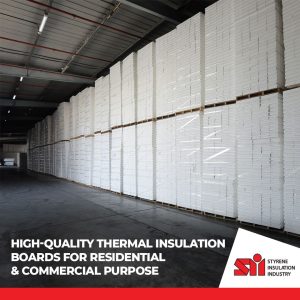
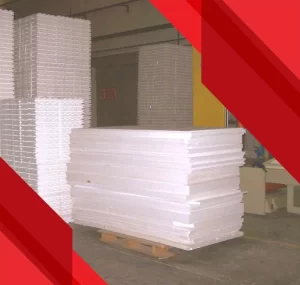
Expanded Polystyrene Sheets are practical where projects need boards cut to defined dimensions, while moulded and custom-cut EPS can suit specialist details. Styrene’s UAE range includes insulation applications for roofs, walls, floors, cold stores, prefabricated houses, service lines, expansion joints, Hourdi construction and void forming.
That range is useful on projects where standard boards are only part of the requirement. A contractor may later need special sizes, shaped pieces or related EPS components. Working with a manufacturer that understands both standard insulation and fabricated EPS keeps those requirements under one technical conversation.
The low weight of EPS is also practical during handling and installation, particularly where large roof or wall areas have to be covered. Boards can be prepared to suit dimensional requirements, allowing contractors to organise installation logically across repetitive building areas.
For prefabricated construction and specialist insulated systems, this ability to manufacture consistent dimensions is particularly useful. Repetition is where properly specified insulation works very well: one approved detail can be carried accurately across a large area.
Specify for UAE compliance and practical supply
Thermal performance, compliance and supply capability belong on the same page. A useful specification connects the declared product properties, approvals, dimensions and available supply with the exact application shown on the drawings.
Dubai Municipality’s current resources place thermal insulation within a formal building-performance framework and identify ASTM C578 for polystyrene thermal insulation. UAE fire and life-safety requirements also address foam-plastic insulation within tested and approved assemblies. The practical approach is to specify the tested grade, thickness and system intended for the particular use and keep the material submittal aligned with the consultant-approved assembly.
Site handling is simple but worth getting right. Boards should be stored clean, dry and protected. Accurate cutting at penetrations and junctions supports continuity. Neat board placement also makes coordination with waterproofing, cladding, screed and MEP work much easier.
Local manufacturing can be useful for phased work and large quantities. Styrene manufactures EPS in Abu Dhabi and states that its Insolite range is produced in multiple sizes and densities for insulation and other applications. When speaking with Polystyrene Manufacturers and Suppliers, ask for the technical data that matches the actual application: grade, density where relevant, thermal conductivity, compressive properties, dimensions, tolerances, standards and available thicknesses.
For EPS Insulation in UAE, the strongest selection process is usually quite direct: building use, position in the envelope, target thermal resistance, mechanical duty, approved system, practical thickness and reliable supply.
A competent manufacturer can make this process much easier because the conversation stays technical. Drawings can be reviewed against available sizes. Required quantities can be planned around the programme. Samples and technical documentation can be prepared during the approval stage. Special cutting can be discussed before material reaches site.
That is usually where good insulation procurement distinguishes itself. The product, technical submittal and construction detail all describe the same solution.
FAQs
1. What are the benefits of using EPS insulation in UAE buildings?
EPS provides effective thermal resistance at low weight and is available in different sizes, thicknesses and densities. It can reduce heat transfer through the building envelope, support stable indoor conditions and complement efficient air-conditioning design.
2. How do you choose the right EPS insulation for a building in the UAE?
Start with the application—roof, wall, floor, cold store or prefabricated system—then check the required U-value, thermal conductivity, thickness, compressive requirement, relevant approvals and the complete construction build-up.
3. How does EPS insulation help reduce heat in UAE buildings?
Its cellular structure resists heat flow. Installed as a continuous layer, EPS slows heat transfer from hot external surfaces toward conditioned indoor spaces.
4. How effective is EPS insulation in the hot UAE climate?
EPS is well suited to hot-climate thermal-insulation applications when the correct grade and thickness are incorporated into a properly designed roof or wall assembly.
5. What is the difference between EPS insulation and other insulation materials in the UAE?
EPS combines low weight, practical board formats, established thermal performance and easy fabrication. Project teams can compare insulation materials through thermal conductivity, mechanical properties, approved system design, thickness and installation requirements.
6. What EPS insulation thickness is suitable for different building applications in the UAE?
Thickness should be calculated from the required U-value and the full construction build-up. Roofs, external walls, floors and cold-store applications can require different thicknesses because their thermal and mechanical duties differ.
7. Is EPS insulation suitable for both walls and roofs in the UAE?
Yes. EPS can be specified for wall and roof systems when the selected grade, thickness, protective layers and complete assembly meet the project design and applicable requirements.
8. What should you consider when selecting EPS insulation thickness?
Consider the target U-value, EPS thermal conductivity, construction build-up, available depth, junction detailing, waterproofing or cladding interfaces and the board sizes available from the manufacturer.
9. How does EPS insulation contribute to indoor thermal comfort?
By reducing heat flow through roofs and external walls, EPS helps moderate the influence of outdoor heat on internal surfaces and supports steadier indoor temperatures.
10. What are the common applications of EPS insulation in UAE construction?
Common uses include roofs, external walls, floors, cold stores, prefabricated buildings, service lines, expansion joints, Hourdi construction, void forming and custom-cut building components.