
Grab a bag of pre-expanded beads, and the first surprise is how heavy they are. Almost none. The fact that a bag the size of a small armchair can be carried up by a single person along a stairwell is already enough to explain much of why polystyrene beads keep cropping up in specifications which used to default to far heavier fillers.
The beads themselves are primarily air. Raw granule is expanded into a closedcell sphere by steam and the closed cells are what matters: they are water-resistant, shape-retaining under load and responsible for low thermal conductivity. The beads can then be poured or blown into cavities, folded through a cement slurry or fused in a mould to produce blocks and boards. You have one raw material, five or six different jobs.
But at the design stage, nobody sits down and asks about the bead itself. Dead load, U-values, a slab that has to falls — all the things you are trained to think about. The bead, silently rectifying.
Lightweight Concrete and Screed
The density — which can be controlled to between about 300 and 1,600 kg/m³ just by varying the amount of bead in the mix — comes from mixing expanded beads into cement and sand. The lower end is suitable for use in non-structural infill and void filling applications. Those real load is at the upper end
As compared to the podium, roof screed is where that pays off most visibly. A roof needs slope to shed water, and in a rainy climate, but a dry climate drop and pour, that pitch has to be right. Polystyrene bead screed constructs the falls without loading the slab with a heavy topping and is pumped up to height easier than a traditional mix. Even podium decks and landscape terraces, which by definition bring dirt and planting right on top of everything else, have the same relief. The underlying structure can remain slimmer, and on a high-rise that savings compounds floor after floor in rebar and formwork.
There is a thermal bonus too. A finished layer insulates a little. Nobody says it for that, but nobody complains.
Insulation Built for Gulf Heat
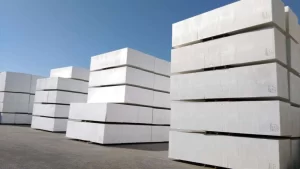
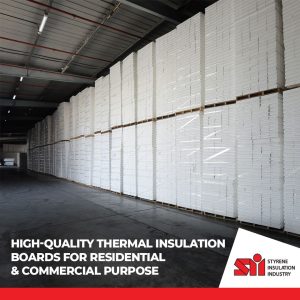
Cooling dominates energy consumption in UAE buildings, and the requirement for better envelopes is greater because of Dubai Green Building Regulations and Estidama (the Abu Dhabi sustainable building programme). Moulded beads answer that directly. Expanded Polystyrene Sheets which are cut from fused blocks, are used in external wall systems under render, roof build-ups, basement insulation beneath floor slabs and as infill behind cladding. It has a thermal conductivity ranging from 0.032 to 0.038 W/mK based on its density (and whether the grade is graphite-enhanced), and the board holds that performance without maintenance.
One fact which I seldom see addressed: Bead size appears directly on the face of board. Finer beads merge together to create a denser surface and denser surfaces give render adhesion more consistent contact. Finer beads are needed for thinner blocks which will require mitred edges and clear resin paneling, with the face being a much bigger issue than in thicker material where the finish on the edge is more important as it may stay unfinished post-hotwire.
Loose beads occupy a quieter space. They are blown into masonry cavities and they will improve the performance of existing walls without ever opening them up, making retrofit work on older villas far less disruptive than you might expect.
Geofoam, Void Formers and Fills
Because so much of the UAE coastline is reclaimed land or built on spongy ground, settlement has become a daily grievance for geotechnical engineers. Moulded from beads at controlled density, EPS geofoam blocks replace heavy soil in embankments, behind bridge abutments and under approach slabs. A block weighs about 1% of the soil it pushes out. The burden on low-strength strata decreases rapidly, and the timeframe almost always shortens as well.
Within a building, blocks take the shape of the void in waffle slabs and rafts. Workers do it by hand with no crane. Thus they always have to adapt the drawings according on site, as site layouts change constantly.
Size, Density and The Supplier Conversation
Raw bead grades generally run from less than 1 millimeter to approximately 3 millimeters prior to expansion, and the grade you choose determines what comes out at the opposite end. Fine grades for thinner boards with smooth faces. Medium grades for general blocks. Big expanded beads for concrete mixes — these need to rest in the matrix as aggregate rather than just disappear into it. The second dial, density controls compressive strength for geofoam or load-bearing screed.
The real separator for anybody that is looking right here for Insolite beads suppliers in UAE, or similar quality and grade and more so if you are comparing bread crumb manufacturer from Turkey too, forget the first delivery as compared to the twentieth delivery: its all about consistency – around size distribution from 20% to 25%, growth ratio between orders. For example, a project that pours screed across eight floors over six months requires the mix to work the same way in month four as it did in month one.
Experienced Polystyrene Manufacturers and Suppliers can help maintain consistent bead quality, density and size distribution across multiple deliveries, reducing variations that could affect construction work.
The polystyrene makers and agents you need to talk with inquire about the application before they state a price tag. Loads, temperatures, finish, pour sequence. Such inquiries indicate a positive sign. When purchasing beads, boards and blocks from a single-source supplier, grades stay uniform across products (and even projects) and only one technical contact fields inquiries on any polystyrene product in a given job.
Customisation On Real Projects
None of this is really off the shelf Density is set at pre-expansion. Boards and blocks specifically for those fire strategies come in flame-retardant grades. Blocks can be drawn, profiled, grooved and sequenced by floor delivery, with hot-wire panel tolerances accurate enough to dry-fit prior to gluing anything.
Different Polystyrene products can be manufactured in project-specific dimensions and density grades, allowing contractors to select materials suited to insulation, lightweight filling and structural void-forming applications.
The freight is more important than the specification. Since the rates were per ton for heavyweight, but by volume for lightweight materials; a lorry is full long before it gets heavy. For example, local production inside the UAE-shortens that chain, cuts transport cost and makes last-minute top-ups possible when a pour date moves forward overnight.
Not only the number, send the drawing out. The supplier that can see the roof build-up or the slab section is often the one suggesting a density, bead grade you did not consider and that is typically where the better result lies.
FAQs
1. What are polystyrene beads and how are they used in construction?
Polystyrene beads are lightweight expanded particles used in concrete, insulation, screed and geofoam.
2. What are the main uses of polystyrene beads?
They are used for lightweight concrete, roof insulation, cavity filling and void forming.
3. How do polystyrene beads improve thermal insulation?
Their closed-cell structure traps air, reducing heat transfer through walls and roofs.
4. Why are polystyrene beads popular in construction?
They are lightweight, easy to install and provide effective thermal insulation.
5. What construction projects use polystyrene beads?
They are used in residential buildings, commercial projects, warehouses and road construction.
6. Are polystyrene beads suitable for insulation?
Yes. They provide effective thermal insulation for walls, roofs and floors.
7. How do you choose the right bead size?
Choose finer beads for smooth finishes and larger beads for lightweight concrete.
8. How do polystyrene beads differ from traditional fillers?
They are generally lighter and absorb less moisture than many traditional fillers.
9. Are polystyrene beads suitable for large projects?
Yes. Their lightweight properties and easy handling make them suitable for large developments.
10. Can polystyrene beads be customized?
Yes. Bead size, density and specific material grades can be selected to meet project requirements.