
A warehouse in the UAE is a large thermal problem before it becomes a storage problem. Thousands of square metres of roof and wall sit under severe solar load, internal air volumes are large, loading doors open repeatedly, and the cooling system is expected to recover without consuming unreasonable energy. Small insulation mistakes become expensive because the envelope is so large.
I would not judge warehouse insulation by thermal conductivity alone. A material can look excellent on a datasheet and still be a poor warehouse choice if it adds dead load, complicates installation, requires expensive support detailing or is awkward to repair after local damage.
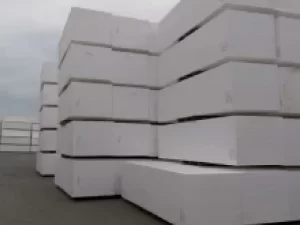
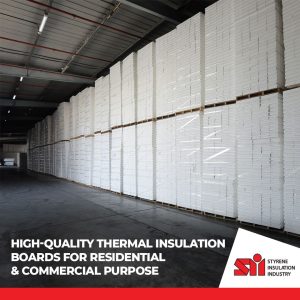
EPS works because the balance is favourable. It is rigid, light, easy to cut and available in densities and thicknesses that can be matched to the construction. Styrene Insulation Industry lists EPS for walls, ceilings, floors and cold-storage applications, broadly the areas where the material makes sense in industrial buildings.
“Best insulation” still needs discipline. PIR can provide more thermal resistance in a thinner build-up. Mineral wool has advantages where non-combustibility or acoustic performance dominates. XPS can be stronger in certain high-moisture or high-compressive-load details. Published UK government comparisons, for example, show a lower thermal conductivity for PIR than for EPS, so claiming that EPS simply has the strongest insulation performance per millimetre would be inaccurate.
None of that weakens the case for EPS in a typical warehouse. It explains why the decision belongs at building level, not on a single laboratory number.
For large roofs, wall panels, insulated partitions and temperature-controlled storage zones, EPS Sheets often give the most useful combination of insulation, handling, predictable geometry and cost.
Why EPS suits the UAE climate rather than merely surviving it
The UAE climate punishes weak envelopes through high external temperature and intense solar gain. The roof usually shows the problem first. A sun-exposed roof can become considerably hotter than the surrounding air, leaving the cooling plant to remove heat that should have been stopped at the envelope.
Rigid EPS reduces heat transfer by trapping air within its cellular structure. The principle is simple; the specification is not. Thickness, density, facing, roof colour, air leakage, panel joints and thermal bridges all influence what happens inside. The US Department of Energy recognises EPS as a common form of rigid insulation used in continuous insulation applications.
For UAE warehouses, continuity is often more valuable than chasing an impressive nominal R-value. I would rather see a correctly installed EPS layer with properly treated joints than a theoretically superior board interrupted by steel members, gaps, crushed edges and casual service penetrations.
This is where Expanded Polystyrene Sheets suit repetitive industrial construction. Large areas can be insulated with straightforward cutting and fitting, while the low weight allows practical handling of substantial board sizes.
Humidity deserves care. EPS should not be treated as a substitute for waterproofing, vapour control or drainage detailing. A warehouse roof still needs properly designed membranes, flashings, penetrations and condensation control. Insulation cannot rescue a roof assembly that allows water or humid air to reach places where it should not.
Dubai Municipality treats insulation as part of a regulated building system. Its current green-building certification information references polystyrene thermal insulation against ASTM C578, while the Dubai Building Code sets the wider framework for building performance and compliance. That matters in the UAE. Buying whatever foam happens to be cheapest on the day is not specification.
Weight, span and installation matter more than brochures suggest
Warehouse structures are repetitive: long spans, portal frames, purlins, cladding rails, metal deck roofs and panelised walls. They reward materials that do not create unnecessary site work.
EPS is extremely light compared with masonry and many traditional construction build-ups. That reduces handling effort and makes it easier to insulate large surfaces without imposing substantial additional permanent load. On retrofit projects, that can matter as much as thermal performance because existing roofs do not always have generous spare structural capacity.
There is another advantage noticed after work begins: dimensional flexibility. EPS Sheets can be cut for repeated bays, service penetrations and non-standard junctions. Styrene’s own product range includes EPS-based boards, blocks and sheets intended for construction and insulation applications, including substantial commercial and warehouse-type projects.
Easy cutting is not permission for careless cutting.
I distrust specifications that are precise about board thickness and silent about joints. A 100 mm board does not behave like 100 mm of continuous insulation if open edges remain around columns, rooflights, cable routes or wall junctions. Crushing beneath fixings or heavy foot traffic before protection is installed creates the same problem locally.
Good warehouse work looks boring.
Tight interfaces. Straight joints. Correct adhesive where required. Proper restraint. Protected edges. No improvised solvent-based product attacking the foam. No gap deliberately hidden behind a flashing because somebody assumes the external panel will compensate for it. Those details sound minor until they are repeated fifty times along a warehouse wall.
That workmanship is one reason established Polystyrene Manufacturers and Suppliers matter more than buyers sometimes assume. Density, thickness tolerance, cutting accuracy and batch consistency affect installation long before anyone sees an energy bill.
The financial case is bigger than the price of the insulation
Warehouse owners often compare quotations by AED per square metre. Understandable, but incomplete.
The real cost includes material, transport, unloading, labour, support framing, cutting waste, programme time, replacement risk and the energy penalty of thermal bridges left after installation. EPS tends to perform well in that calculation because transport and handling are relatively straightforward and large repetitive areas can be covered efficiently.
The low weight also changes labour productivity. A crew handling heavy boards becomes slower over a long roof shift. Lighter material does not remove access, lifting or safety requirements, but it reduces physical handling demand. On a sizeable distribution centre, a few minutes saved in one operation becomes a meaningful amount of labour once that operation is repeated hundreds of times.
Then there is cooling. Insulation does not reduce an electricity bill by a guaranteed percentage. I would be suspicious of anybody promising that before knowing the building.
Savings depend on operating hours, thermostat settings, door opening, air leakage, roof exposure, stored products, internal machinery and HVAC efficiency. What insulation can do is reduce conductive heat gain through the part of the envelope that has been treated. In an air-conditioned UAE warehouse, that is heat the cooling system no longer needs to deal with through that surface.
EPS Sheets become particularly persuasive where the building does not require an ultra-thin wall or roof.
EPS can require more thickness than higher-performing foam insulation to achieve the same thermal resistance. Government comparisons of insulation materials illustrate that difference clearly. Warehouses, however, frequently have enough physical space to accept the additional thickness. Paying substantially more simply to recover a few centimetres may offer very little operational value.
The useful question is not, “Which board has the highest R-value?” It is, “Which compliant assembly gives the required U-value, fire performance and service life at the lowest sensible installed cost?” That is a different calculation.
Where EPS can fail — and why specification matters
The common mistake is treating every EPS grade as the same. It is not.
Density, compressive strength, dimensional tolerance and intended use have to suit the detail. A lightweight board intended for simple wall insulation should not suddenly appear beneath a heavily loaded floor because somebody found unused stock in another part of the project.
Fire is the second area where shortcuts are unacceptable.
EPS is a combustible polymeric insulation. Government technical guidance comparing insulation materials identifies its fire behaviour clearly, which is why EPS has to be considered as part of the complete tested or approved construction rather than judged as an exposed board in isolation.
Correct grade, facings, protective layers, barriers, fixings and fire-stopping matter. A warehouse containing packaging materials, chemicals or a particularly high combustible load may present a very different fire-design problem from a general dry-goods facility. UAE authority requirements, Civil Defence requirements, the project fire strategy and approved certification take priority over a supplier’s generic description of a board as “fire retardant”.
Dubai Municipality requires thermal insulation materials to meet applicable standards and certification requirements. Its Al Sa’fat guidance also places thermal insulation inside a wider regulated building-performance framework.
UV exposure is another avoidable mistake. Insulation boards should not be left exposed through an unnecessarily long construction programme simply because installation of the protective layer has slipped.
Chemical compatibility gets missed as well. Adhesives, sealants and coatings need to be suitable for polystyrene. “Construction adhesive” written on a cartridge is not enough information.
Later alterations cause their own damage. Electricians cut a new opening. A refrigeration contractor adds pipework. Somebody enlarges a cable penetration. Nobody reinstates the insulation properly. The original insulation specification gets blamed two years later.
Rodent damage, repeated warehouse impact, careless maintenance access and water entry from failed roof components can compromise an otherwise sound installation too. The EPS core itself generally asks for very little once it is correctly enclosed. The building around it still requires inspection.
For Styrene Insulation Industry, the useful conversation is not simply which Polystyrene products can be supplied. It is which density, thickness and format match the warehouse envelope, expected internal conditions, structural arrangement and authority requirements. That distinction matters more than the product brochure.
FAQs
1. Why is EPS insulation ideal for warehouses in the UAE?
Because it combines effective thermal resistance with very low weight, practical large-area installation and competitive installed cost. Those characteristics suit buildings with extensive roofs and walls exposed to sustained UAE heat.
2. What are the benefits of using EPS insulation in warehouses?
Lower conductive heat gain, reduced cooling demand, easy handling, flexible sizing and relatively low structural weight. It is particularly useful where large repetitive areas need to be insulated economically.
3. Why do warehouse owners prefer EPS insulation over other materials?
Usually because the complete project economics work well. Transport, installation speed, handling, support requirements and available wall or roof thickness can all favour EPS even when another material has a better thermal value per millimetre.
4. Is EPS insulation suitable for large industrial warehouses?
Yes. EPS Sheets are particularly practical across large repetitive surfaces, provided the grade, thickness, fire performance and complete construction system are suitable for the building.
5. How does EPS insulation protect warehouses from extreme UAE temperatures?
It slows conductive heat transfer through insulated roofs and walls. It cannot stop heat entering through open loading doors, uncontrolled air leakage, glazing or uninsulated steel bridges, so the envelope still has to work as a complete system.
6. How does EPS insulation help maintain consistent indoor temperatures?
By reducing the rate at which external heat moves through insulated surfaces. The HVAC system then deals with a more manageable envelope load, helping reduce temperature fluctuations when air leakage and door opening are also controlled.
7. Is EPS insulation suitable for both new and existing warehouses?
Yes. It can be designed into new roof and wall systems or incorporated into retrofit work, subject to structural capacity, moisture detailing, fire requirements and the condition of the existing construction.
8. Is EPS insulation lightweight enough for large warehouse structures?
Yes. Low weight is one of its strongest practical advantages, particularly across extensive roof and wall areas where heavier systems can increase both handling and structural demands.
9. Does EPS insulation require regular maintenance?
The enclosed insulation itself generally needs little routine maintenance. Roofs, cladding, membranes, joints and service penetrations still need inspection because water ingress or physical damage can compromise the complete insulation system.
10. Can EPS insulation improve the lifespan of warehouse buildings?
Yes, indirectly. A properly designed insulated envelope can reduce severe temperature cycling and help control condensation risk within the construction. It cannot compensate for corrosion, poor waterproofing, failed seals or neglected building maintenance.