A quotation can look perfectly reasonable and still be for the wrong material.
That is where quite a few purchasing decisions go wrong. The buyer asks for EPS of a certain thickness, several suppliers quote, and the discussion moves immediately to price per sheet, block or cubic metre. Density, dimensional tolerance, compressive requirement, thermal duty and the actual conditions in which the material will be used sometimes receive surprisingly little attention.
Polystyrene is not bought for one type of work in the UAE. It may be going behind a wall as insulation, beneath a civil engineering structure as lightweight fill, around delicate equipment as protective packaging, into an insulated box, inside a concrete block or through a contour-cutting process to produce an architectural shape.
Those are not interchangeable requirements. A competent supplier should start asking questions before offering a price. What is the application? What density has been specified? Is there a drawing? Does the consultant require particular test documentation? Is the material being exposed to significant compressive loading? What thickness and tolerance are acceptable? Is the quantity a one-off requirement or part of a phased project?
If the discussion never gets beyond dimensions and quantity, I would be cautious. Good Polystyrene Manufacturers and Suppliers should be able to connect the manufacturing specification to what happens after the material leaves their premises.
The UAE climate adds another consideration. Insulation materials are often working in buildings where controlling heat transfer has a direct effect on cooling demand. EPS is widely used precisely because its cellular structure combines low weight with useful thermal insulation characteristics. Its performance still depends on selecting the correct grade and installing it properly; simply specifying “polystyrene” is not enough. Styrene Insulation Industry describes its EPS manufacturing as a three-stage process involving pre-expansion, intermediate ageing and moulding, which is broadly where control of the finished material begins.
There is also a tendency to over-specify. Higher density is not automatically better for every job. Paying for a heavier grade without a mechanical or project requirement can simply increase material cost. Under-specifying density creates a different problem entirely. The specification should win that argument, not habit.
Examine manufacturing control before examining the sales brochure
Two samples of EPS can look almost identical on a desk. That tells you very little.
Consistency becomes visible when hundreds or thousands of pieces arrive. Sheets vary in thickness. Cut edges are untidy. Blocks do not correspond properly with drawings. Density changes between batches. Packaging inserts fit the first shipment but not the second. A supposedly simple saving on the purchase order then appears as trimming, rejection, site adjustment, wasted labour or an argument over replacement material.
This is why I place considerable weight on manufacturing control.
Ask where the material is actually made. Ask whether the company manufactures or merely distributes it. Ask how density is controlled. Ask what cutting equipment is available. Ask how custom dimensions are checked. If the project carries technical requirements, ask what supporting records can be supplied.
Certification also deserves a proper look, though I would not treat certificates as decorative badges on a website. Check what the certification covers and whether it is relevant to what you are purchasing. Styrene Insulation Industry currently lists DCL, BSCIC, OHSAS and ISO certifications on its certification page.
Experience matters here, but years in business by themselves prove less than buyers sometimes assume. A factory can have operated for decades and still be poor at a specialised product. What matters is sustained manufacturing experience combined with the equipment and technical understanding required for your particular application.
Styrene states that it began manufacturing EPS injection- and block-moulded products under its Insolite brand in 1995. It manufactures from Abu Dhabi and lists products extending from insulation blocks, sheets and boards to block inserts, boxes, packaging, beads, geofoam, pontoons and contour-cut components.
That breadth matters when evaluating Polystyrene Manufacturers and Suppliers, not because a longer catalogue automatically produces better material, but because different manufacturing processes reveal more about what the factory can actually control.
There is a practical test I prefer over a polished capability statement: send the supplier an awkward enquiry. A non-standard dimension. A shaped component. A specified density. A drawing with tolerances. Ask how they would manufacture it. The quality of the questions coming back tells you quite a lot.
Customisation must happen on the factory floor, not only in the quotation
“Custom size available” has become almost meaningless. The question is how it is achieved.
There is a substantial difference between cutting a standard board down with limited control and manufacturing or accurately profiling material around the final requirement. Construction inserts, protective packaging, decorative profiles, buoyancy components and engineering applications can involve dimensions where a few careless millimetres create unnecessary trouble.
Contour cutting is particularly useful where the requirement moves beyond rectangular blocks and sheets. Styrene lists contour cutting among its UAE manufacturing capabilities and describes computer-controlled cutting for custom forms in its architectural applications.
For a buyer, the conversation should include tolerances. Do not send a drawing and assume everybody interprets it the same way. State which dimensions are critical. Confirm whether the drawing dimensions refer to the finished part. For packaging, test the actual item inside the insert rather than approving purely from a CAD drawing. Products are not always dimensionally identical to their technical drawings, particularly where handles, fittings, connectors or production variations are involved.
Prototype first when the cost of getting the final production run wrong is high.
The client website states that samples can be supplied on request, including where customers are uncertain about the appropriate material. That is worth using. A sample is not merely for checking whether the foam “looks good”. Check dimensions, density where relevant, surface condition, cutting accuracy, fit and how the component behaves during the actual handling or installation process.
I would also ask whether subsequent production will follow the approved sample specification. The prototype is of little value if the production batch is treated as a fresh interpretation.
Customization is equally relevant when purchasing Expanded Polystyrene Sheets. Standard dimensions may be perfectly adequate for routine insulation work. Non-standard thicknesses, densities or cutting requirements can reduce site wastage when the quantity justifies making them specifically for the project.
Not every customised requirement is economical. A small order involving complex tooling, repeated design changes or extremely tight tolerances may be better produced in a different material. A credible supplier should be prepared to say so rather than forcing EPS into an application simply to secure the order.
Product quality should be defined in measurable terms
“High quality” is not a specification. Neither is “premium”.
When evaluating Polystyrene Manufacturers and Suppliers, turn quality claims into questions that can produce useful answers.
What density is being supplied? What tolerance applies to dimensions? Is a fire-retardant grade required? What compressive performance is relevant to the intended application? What test information is available? Can batches be identified? For a recurring supply contract, how is consistency maintained?
The questions change with the job. For thermal insulation, density, thickness and thermal performance deserve attention. For geofoam, engineering properties and compressive behaviour can be critical. For packaging, cushioning performance, shape and fit may matter more than a construction buyer’s usual parameters. For food, produce or temperature-sensitive packaging, suitability for the intended use needs to be confirmed rather than assumed.
Styrene’s current product range includes EPS insulation boards and sheets, block inserts, vegetable and dates boxes, ice boxes, packaging components, EPS beads, geofoam and pontoons. Calling all of these simply Polystyrene products conceals how different their working requirements actually are.
Samples help, but they have limits. You cannot reliably establish long-term thermal performance, engineering suitability or production consistency by squeezing a small piece of foam between your fingers. I still see informal assessments of foam made this way. “This one feels harder” is not technical evaluation.
Documentation beats finger pressure. Visual inspection does have a place. Look for damaged corners, unexpected voids, poor fusion, inconsistent cutting, warped pieces and dimensional variation. For shaped components, assemble or trial-fit them. If twenty pieces have to form one repeating detail, test several pieces together rather than inspecting one in isolation.
Quality also includes the material arriving in usable condition. EPS is light, which makes handling easy, but careless storage and transport can damage edges or surfaces before installation. Delivery packaging and site handling should be discussed for large or dimensionally sensitive components. Cheap material that requires site repair is not cheap.
In-house manufacturing changes the supply conversation
There are perfectly competent distributors in the market. A distributor is not automatically a poor choice.
The difficulty begins when the buyer needs technical changes quickly and the company taking the order does not control production.
Suppose a contractor discovers that a block insert needs a dimensional adjustment after a site trial. With an actual manufacturer, technical and production teams can potentially assess that change directly. Through several layers of trading, the same revision can become a chain of messages: contractor to purchasing department, purchasing department to supplier, supplier to importer or manufacturer, then back again.
Details disappear surprisingly quickly in chains like that.
In-house manufacturing also matters when supply is phased. UAE projects do not always consume material in one delivery. Quantities change. Site programmes move. A consultant may revise a detail. Extra material may suddenly be required to recover lost time.
Before appointing a supplier, ask what happens after the first purchase order.
What is the normal production lead time? How quickly can repeat orders be manufactured? Does the supplier operate its own transport or coordinate third-party delivery? Can it handle Abu Dhabi, Dubai, Sharjah and more distant project locations reliably? How should large-volume EPS be scheduled when storage space on site is limited?
EPS creates an unusual logistics issue because it is extremely light but occupies considerable volume. A purchasing team looking only at material weight can underestimate transport and storage requirements. Large blocks and sheets need physical space. Ordering too early can obstruct a congested site; ordering too late can stop an installation crew.
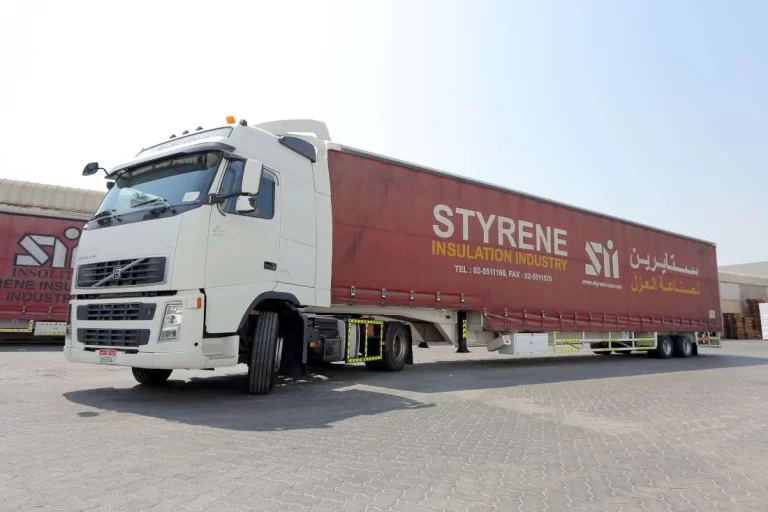
Delivery sequencing matters. Styrene manufactures from its premises in Abu Dhabi and lists general transport alongside its production activities. Its website also identifies an extensive manufacturing range rather than a single EPS product line. For buyers comparing Polystyrene Manufacturers and Suppliers, this is the kind of operational information worth examining alongside the quotation.
Price still matters. Of course it does. I would compare total supplied cost rather than the cheapest unit figure: material, cutting, tooling where applicable, delivery, minimum quantities, wastage, replacement terms and the cost of correcting inaccurate parts.
Five per cent saved at purchasing stage disappears very quickly when twenty installers spend half a day modifying material on site.
Questions UAE buyers should settle before issuing the purchase order
The final selection becomes easier once the vague questions disappear.
Ask for the exact specification on the quotation. Confirm density rather than relying on a verbal conversation. Attach the approved drawing to the purchase order for customised components. Record revision numbers. Confirm quantities by size. Agree tolerances where dimensions matter. Check delivery location and access restrictions. Decide who is responsible for unloading and appropriate storage.
For repeat production, retain the approved sample or drawing reference. Do not assume the next person handling the order knows what was agreed three months earlier.
A supplier relationship is working properly when these details become routine. You send a technically clear enquiry; the factory understands it; production corresponds with the approval; material arrives when expected; repeat orders do not require the whole specification to be rediscovered. That reliability usually has more commercial value than a small difference between two quotations.
FAQs
1. How do you choose the best polystyrene supplier in the UAE?
Choose a supplier that can demonstrate manufacturing capability, consistent material specifications, suitable certifications, customisation where required and reliable UAE delivery. Ask technical questions before comparing prices. A supplier that understands the application is generally more useful than one that simply quotes the requested dimensions.
2. What factors should you consider when selecting a polystyrene supplier?
Look at manufacturing capability, density control, product range, dimensional accuracy, technical support, certification, custom-cutting capacity, lead times and delivery arrangements. For recurring orders, consistency between batches deserves particular attention.
3. Why is choosing the right polystyrene supplier important for your business?
Incorrect density, inaccurate dimensions, poor cutting or unreliable deliveries can create waste, installation delays and replacement costs. The purchasing price is only part of the real cost of the material.
4. How can you evaluate the quality of polystyrene products before buying?
Request the technical specification and, where appropriate, a sample. Inspect dimensions, finish and cutting accuracy and test the product in its intended application. For technical performance, rely on relevant test information rather than appearance alone.
5. How important is product customization when choosing a polystyrene supplier?
Yes, it can be very important when standard blocks or sheets do not fit the application. Packaging inserts, insulation components, architectural shapes and specialist construction work can all benefit from controlled custom cutting or moulding.
6. Why is manufacturing experience important when choosing a polystyrene supplier?
Yes, manufacturing experience matters because EPS performance depends on controlled expansion, ageing, moulding and cutting. Experience is most valuable when it is supported by appropriate equipment, process control and knowledge of the intended application.
7. What is the advantage of choosing a supplier with in-house manufacturing?
Yes, in-house production can provide better control over specifications, custom sizes, production scheduling and revisions. It can also shorten the communication route when a project requires a technical change.
8. Why is product quality important when choosing a supplier?
Consistent quality reduces rejected material, dimensional problems, installation work and unexpected performance issues. For construction and engineering applications, it can also be critical to meeting the project’s specified requirements.
9. Does the supplier offer customized polystyrene products?
Yes. Styrene Insulation Industry offers tailor-made EPS solutions and lists contour cutting, moulded products and a range of specialised applications among its manufacturing capabilities in the UAE.
10. Can I request product samples before placing an order?
Yes. Styrene Insulation Industry states that free samples are available on request, particularly when a customer needs help determining which EPS solution is appropriate for the intended use.